
Explore how in-shell processing can transform your production line.
Schedule a demo or consultation to see how you can boost yields and eliminate waste with RE-NUT’s technology.
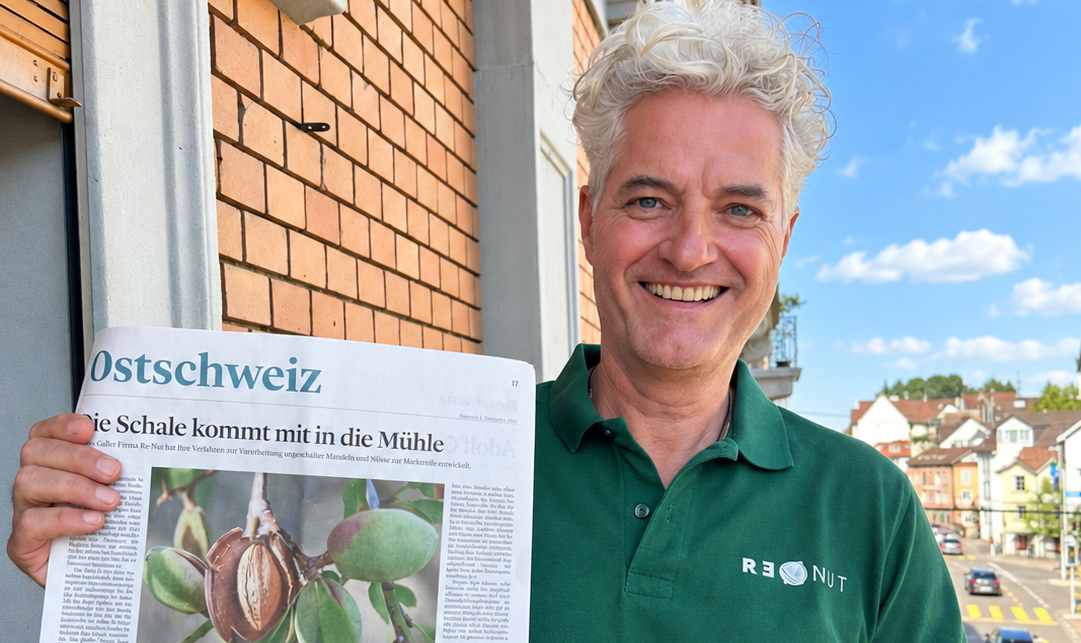

RE-NUT® was recently featured in the St. Galler Tagblatt, the largest daily newspaper in Eastern Switzerland and one of the leading newspapers in German-speaking Switzerland.
The article, published on September 2, 2026, takes a closer look at RE-NUT®’s technology for processing almonds and nuts together with their shells, the journey from development to industrial scale, and our plans for commercial production in the United States. It also highlights our collaboration with Bühler and the broader potential of using raw materials more efficiently.
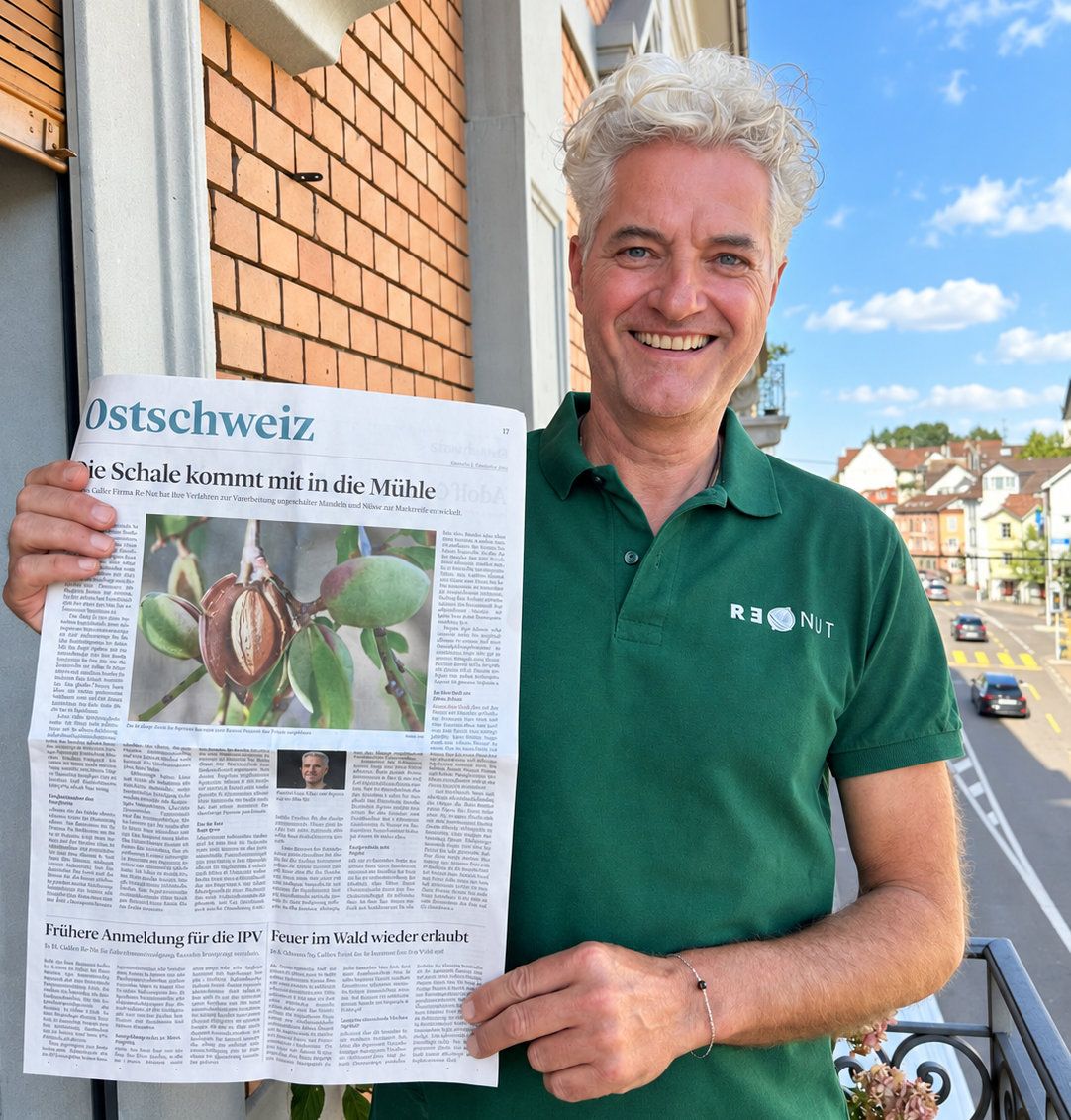 English translation of the article by Thomas Griesser Kym:
An inconspicuous building near St. Gallen railway station on Rosenbergstrasse, located between Haus Washington and the Palace. This is where RE-NUT, a start-up founded in 2022, has its offices with a small team.
Co-founder and CEO Roland Laux welcomes us for a conversation. The Thurgau native from Roggwil serves a drink that is not yet available on the market and has so far achieved recognition in the United States by a Panel of Qualified Experts. It is a special almond drink. It is creamier and tastes more natural than many alternatives found in cartons on supermarket shelves. And it differs from these products in the way it is produced: instead of removing the shells first, the almonds are processed together with them.
Using its patented processes, Laux can apply the same principle to many different types of nuts, from peanuts and hazelnuts to walnuts.
Laux, formerly a marketing specialist at Nestlé and now with 30 years of experience in the food industry, explains the advantages. Around 70 million tonnes of nuts and almonds are produced worldwide every year, and the figure is rising. Around half of their mass consists of shells.
These are burned, used as animal feed or as bedding on cattle farms. Very little money is generated from them.
“By processing the shell as well, the yield increases significantly — by 30 percent for peanuts and by as much as 70 percent for walnuts,” says Laux.
The shells are also rich in dietary fibre and antioxidants such as vitamin E. Thanks to the higher yield, resources such as the land and water required for the trees can also be used more efficiently.
The idea of processing nuts and almonds together with their shells came to Laux and food scientist Tilo Hühn, who have worked together for many years, around ten years ago during a visit to hazelnut plantations in Turkey.
Since then, Laux and Hühn have developed their process to commercial readiness, with significant involvement from their Chief Technology Officer and long-time collaborator Christian Zimmermann.
The process uses wet milling. One part almonds and four parts water are placed in a mill. The two ingredients are ground into a slurry, which is then separated in a centrifuge into nut liquid and nut flour.
No additives are used, the liquid is ready to drink, and the flour can be used for cookies, bars, chocolate, ice cream, breakfast cereals or baking mixes. It can also replace part of the sugar in sweet spreads.
RE-NUT has now reached the stage where the idea can be commercialised.
In the United States, Yahya Abbas tasted the almond milk and called Laux — according to Laux, completely enthusiastic about it. Abbas is the founder of Ya Ya Foods, the second-largest contract manufacturer of plant-based beverages in North America, producing products for companies including Nestlé and Danone.
Abbas and RE-NUT are now jointly investing in the first industrial production facility in the USA[SI1] for almond milk and almond flour as part of a joint venture.
Abbas is putting up USD 56 million for the construction of a turnkey factory building in the state of Michigan.
RE-NUT, meanwhile, has launched a financing round to raise CHF 6 million from investors, including investors from Eastern Switzerland, for the production equipment. The equipment will be manufactured by GEA and two other German machinery manufacturers.
Laux outlines the roadmap: he aims to have the financing for the equipment secured by late autumn. Everything should be ready for production in the third quarter of 2027, with operations planned to begin in 2028.
Abbas will be responsible for manufacturing and distributing the almond milk and almond flour at his own expense. RE-NUT will receive a licence fee based on the quantity of almonds processed.
Laux is confident about the prospects for success. Two large consumer tests in New Jersey and Los Angeles have recently shown that the almond milk is very well received, including in comparison with products from other manufacturers.
The company is also working to obtain food approval in Europe for its almond and nut products, a process that generally takes somewhat longer than in the United States.
Laux sees one potential risk in competitors attempting to replace the water used in the wet milling of almonds or nuts with vegetable oil, thereby using a dry-milling process instead.
But RE-NUT has prepared for this as well: the oil-based process, which can be used to produce an almond or nut paste, is also patented.
For the equipment used in this process, RE-NUT is collaborating with the Uzwil-based Bühler Group.
Cathrin Flühler, Head of the Nuts Market Segment at Bühler, says:
“Bühler has been working with RE-NUT for almost two years and supports the technological development of the approach to producing peanut butter from unshelled nuts with its expertise in food processing.”
Flühler continues:
“The idea of using raw materials as efficiently as possible and unlocking new value-creation potential fits very well with our strategic priorities in sustainability and Future Food. We therefore follow innovative approaches like this with great interest.”
The idea behind the nut and almond process grew out of earlier projects by Laux and Hühn.
In 2006, after visiting a chocolate factory, they decided to grind unroasted cocoa beans with cold water into a slurry and then separate it into cocoa butter, cocoa powder and liquid aroma, rather than dry-processing the beans under high pressure and at high temperatures and, in doing so, effectively burning away the aroma.
In 2015, Laux and ZHAW, where Hühn teaches, sold the patent to Yello musician Dieter Meier. He uses the technology to produce his “Oro de Cacao” chocolate and the special extract Phytho Cacao, now produced in Freienbach.
Laux implemented another application of the technology with Migros in 2017 for cold-brew coffee. After some time, however, the retailer stopped production at its Bischofszell subsidiary Bina.
Looking back, Laux says:
“We were too early with cold-brew coffee. At the time, everyone was drinking Caffè Latte. But now the time is ripe for Cold Brew here as well.”
Original article: Thomas Griesser Kym
Published: 2 September 2026
Original language: German
Schedule a demo or consultation to see how you can boost yields and eliminate waste with RE-NUT’s technology.
).jpg?width=896&height=672&name=Untitled%20(Presentation%20(43)).jpg)